
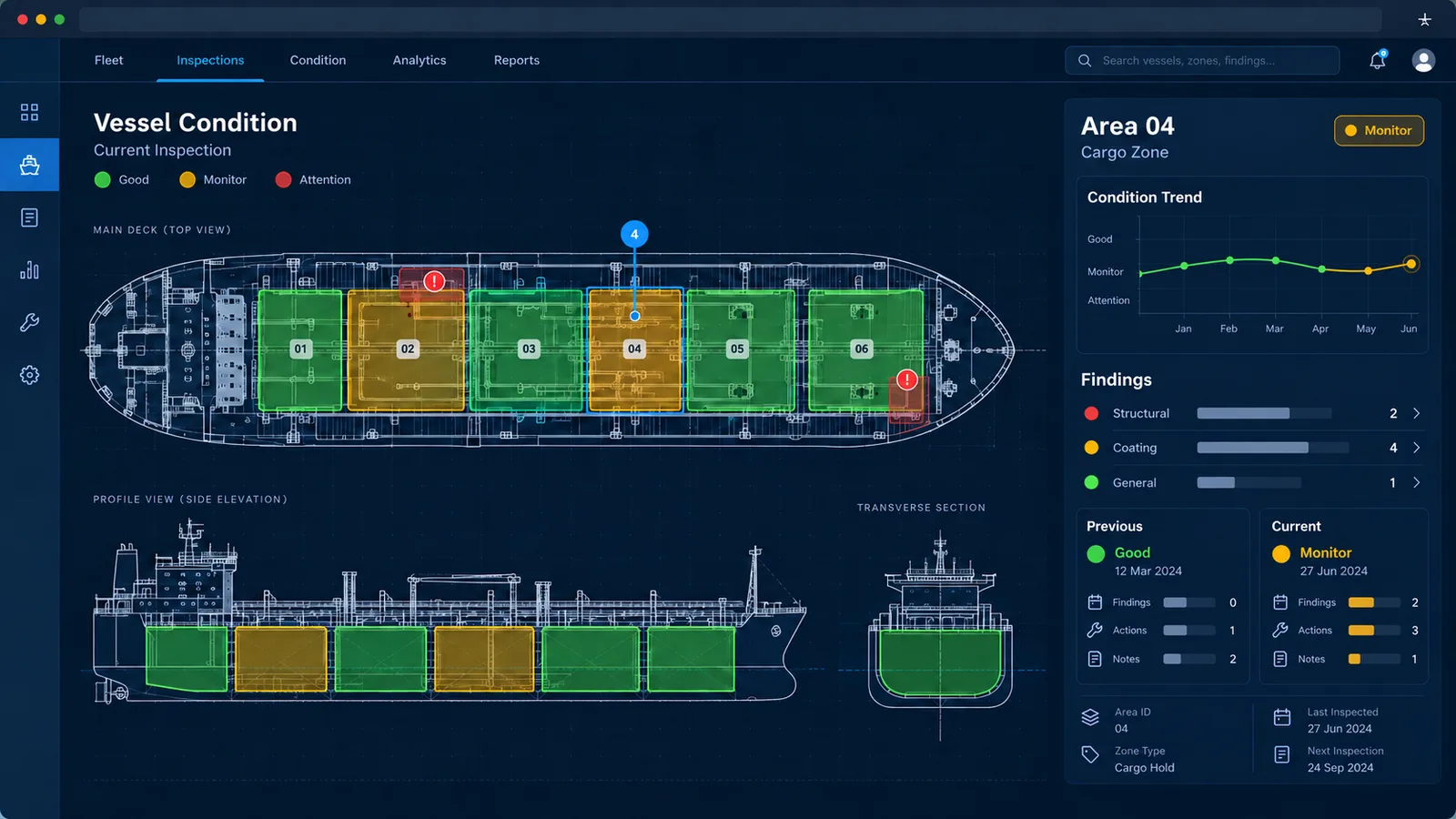
Navirego AI helps ship operators spot the rule changes that matter, stay audit-ready and run consistent inspections. Idealite built the complete platform.
Visit live site ↗ (opens in a new tab){ Project Overview }
About the Project
Ship operators answer to the IMO, flag administrations and class societies, and their rules keep changing. Each update has to be read, judged against every vessel and worked into the Safety Management System, yet some teams still track this in Excel and email threads. One overlooked amendment can mean non-compliance at audit, with penalties and reputational damage, and when the audit window opens, teams scramble for evidence. Inspections, where compliance is checked on board, have a similar gap: findings sit in separate, differently structured reports, so recurring deficiencies slip past. Navirego AI shows compliance teams the rule changes relevant to their fleet, links them to their procedures with a timestamped record and answers questions from their own manuals. Inspectors capture evidence in one place, AI drafts findings and experts confirm every technical conclusion. Idealite built the complete platform, compliance and inspection features alike, across backend, frontend and AI architecture.
- Industry
- Compliance
- Services
AI Architecture • Backend Development • Frontend Development
{ The Challenge }
Staying Compliant While Maritime Rules Keep Changing
Key Challenges
- Relevant changes buried in irrelevant updates
- One missed amendment risks audit penalties
- Compliance tracked in spreadsheets and email
- Audit preparation becomes a last-minute scramble
- Company knowledge locked in unstructured documents
- Recurring deficiencies hidden across separate reports
{ Our Solution }
One Platform for Compliance, Knowledge and Inspections
- Fleet-relevant change alerts
- Audit-ready compliance record
- Company knowledge on demand
- Consistent inspection evidence
- Vessel condition history
- Evidence-backed findings
{ How We Built It }
Development Process
How the Navirego AI engagement came together, step by step.
- 01
Built Around Compliance Risk
Shaped the platform around where operators carry compliance risk: rule changes, audit evidence and inspection reports, for shore-based safety managers, superintendents and marine inspectors.
- 02
Cut the Noise
Gave each fleet only the rule changes that apply to its vessels, explained in plain language, so teams spend review time on what matters.
- 03
Audit Readiness Every Day
Made the compliance record build up as teams act on each change, so audit preparation stops being a last-minute sprint.
- 04
Knowledge Within Reach
Put company manuals and procedures within reach of a plain-language question, so expertise is easier to share across the company.
- 05
One History per Vessel
Made every inspection, from template inspections to crew checks, add to one comparable vessel history, so recurring problems surface early.
{ Tools We Used }
Technology Stack
 Next.js
{ Results & Impact }
Delivering Business Value
Focused Regulatory Watch
Compliance teams see the rule changes relevant to their fleet, in plain language.
Steady Audit Readiness
Auditors can see when each rule changed and how the team responded.
Expertise Shared Widely
Teams can draw on company procedures without hunting through manuals.
Recurrence Made Visible
Operators spot recurring deficiencies across inspections and act on them early.
Technical details
Requirements, architecture, development, testing and deployment notes.
Technical details
Requirements, architecture, development, testing and deployment notes.
Objectives
- Spot Relevant Changes: Show each fleet only the IMO, flag and class changes that apply to its vessels, so relevant amendments are not lost in the noise.
- Make Audit Readiness Routine: Build audit evidence as teams handle each rule change, so proof of compliance is ready whenever auditors ask.
- Unlock Company Knowledge: Let staff find answers in their own manuals, procedures and ship files by asking in plain language.
- Consistent Inspections: Give every inspection the same way to capture evidence and record findings, so vessel condition can be compared over time.
- Keep Experts in Control: Let AI organize evidence and draft findings while experts confirm every technical conclusion.
Requirements
- One database of international, national and local maritime regulations, updated continuously
- Monitoring of IMO, flag-administration and class-society sources, with alerts and change summaries
- Relevance filtering by flag, vessel class and operation type
- Changed clauses highlighted, compared with the previous version and summarized in plain language
- Links from updated clauses to Safety Management System (SMS) procedures, with review tasks and progress tracking
- Timestamped version history and action log for audits
- AI knowledge retrieval over company documents, manuals and procedures, plus a library for company- or ship-specific uploads
- Inspection capture from templates (MLC, PSC, SIRE, RightShip and others), free-form inspections or crew checks, with photos and video
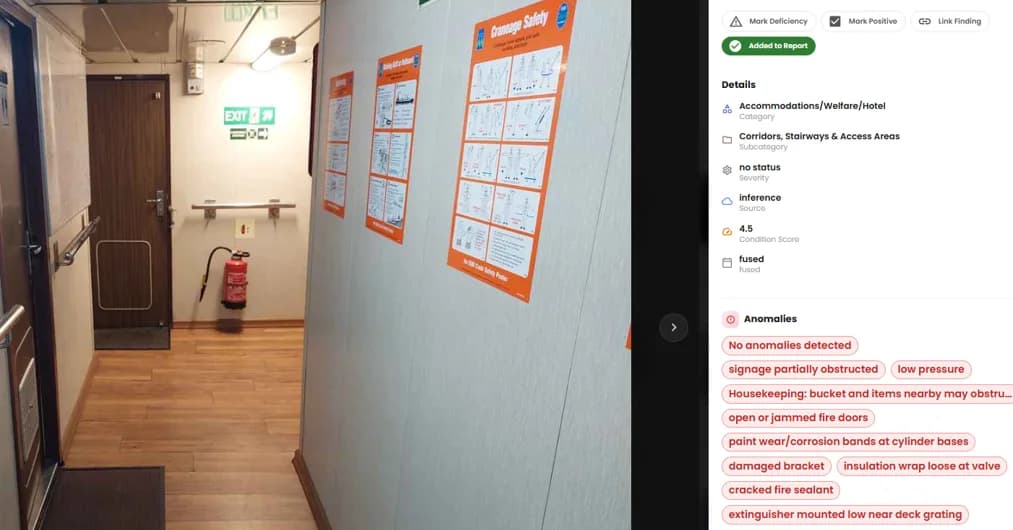
- AI-flagged anomalies and AI-drafted findings, with every technical conclusion validated by a human expert
- REST API integration, multilingual support, data privacy and cloud security
Architecture
- Complete backend, frontend and AI architecture by Idealite, spanning compliance and inspection features
- Regulatory knowledge base of international, national and local maritime rules, with source monitoring and version history
- AI retrieval layer that answers questions over company documents, manuals and procedures
- Text models tag inspection remarks under one taxonomy; vision models categorize photos and flag anomalies
- Findings grouped by risk area, location, frequency and recurrence into a searchable knowledge graph
- Human-in-the-loop review: AI drafts findings and summaries, experts validate technical conclusions
Technology stack
- Next.js
Front end
- Next.js web app
- Regulatory search, change alerts and review tasks linked to Safety Management System (SMS) procedures, for Designated Persons Ashore (DPAs) and compliance teams
- Chat interface for questions over company documents, manuals and procedures
- Inspection capture from templates, free-form inspections or crew checks, with photos and video
- Evidence review with AI-flagged anomalies and Mark Deficiency, Mark Positive and Link Finding actions
Back end
- Regulations store with continuous updates and version history
- Monitoring of IMO, flag-administration and class-society sources, with change alerts
- Review-task tracking and timestamped action history for audits
- Document library for company- and ship-specific information
- Inspection records holding checklist answers, observations, findings, photos and video
- REST API for integration with existing systems
Challenges & solutions
- Volume of change: hundreds of updates appear every month from the IMO, flag states and classification societies, and each must be read, interpreted for every vessel and incorporated into the Safety Management System (SMS).
- Noise: many updates are irrelevant to a given fleet, but each still has to be checked to be sure.
- Cost of a miss: a single overlooked amendment can mean non-compliance during an audit, exposing the operator to penalties and reputational damage.
- Scattered tracking: some teams track regulations in Excel, others assign follow-ups through off-the-shelf tools or email threads, and updates to ships travel through email chains that easily get lost.
- Limited time: without continuous monitoring, teams often verify compliance only before an audit, and Designated Persons Ashore (DPAs) can check only a sample of processes or vessels.
- Audit pressure: when the audit window opens, teams scramble to pull documents and gather evidence, so audit readiness becomes a sprint.
- Hard-to-access knowledge: maritime documents and compliance reports are unstructured and often go unused.
- Isolated inspection reports: findings sit in separate, differently structured reports, so recurring deficiencies are easily missed until they turn into off-hire, detention or unbudgeted costs.
- Subjective inspections: results depend on who looks, how they rate it and which photos are submitted, so important areas can be missed.
- Trustworthy AI: in safety-critical work, AI output must stay explainable and every technical conclusion human-validated.
Outcomes
- Compliance teams spend review time on the IMO, flag and class changes that apply to their fleet, with plain-language summaries of what changed
- Audit evidence builds up as teams act on each change, in a timestamped record linked to Safety Management System procedures
- Staff draw on company manuals, procedures and ship files by asking in plain language, instead of hunting through documents
- Every inspection, whether from a template, free-form or a crew check, adds to one comparable condition history per vessel
- Each assessment shows the evidence, severity, coverage and recency behind it, so operators can see why each finding was made
Next case study
Clearer Parcel and Supplies View for UK Post Office Teams
{ Let's Build Together }
Let's build what's next
We partner with ambitious businesses to design, build and scale digital products that create lasting value.
Contact Us