

Helping banks reach the right investors and close loan deals with less manual work. Idealite's founder worked closely with the iLex team.
Visit live site ↗ (opens in a new tab){ Project Overview }
About the Project
Syndicated loans let a group of lenders share one large corporate loan, in a market QBN Capital, an iLex investor, put at US$5 trillion in 2023. Yet iLex describes how these loans are distributed and traded as still "manual, time-intensive, repetitive and error-prone" after decades of little innovation. In practice, what a bank knows about investors sits in bankers' inboxes and call notes, so a deal mostly reaches the investors a team already knows. NDAs, document access and allocations are chased across separate channels, and deal data is typed again into disconnected systems. Investors lack one view of the deals open to them, secondary loans lack liquidity and price data, and regulation and costs keep rising. iLex, operating from London, Paris, Hong Kong and Singapore, brings this work onto one secure platform for syndicated loans, secondary trading and private credit, used by multiple companies to share loans. Harshit, Idealite's founder, worked closely with the iLex team on the platform.
- Industry
- Finance
- Services
Platform Collaboration • Product Development Support
{ The Challenge }
Syndicating a Loan Is Still Slow, Manual and Costly
Key Challenges
- Deals still run on email and spreadsheets
- Investor reach limited to known relationships
- NDAs, documents and allocations tracked by hand
- Deal data re-keyed across disconnected systems
- Secondary loans lack liquidity and price data
- Rising regulatory demands and operating costs
{ Our Solution }
From Finding Investors to Closing the Deal
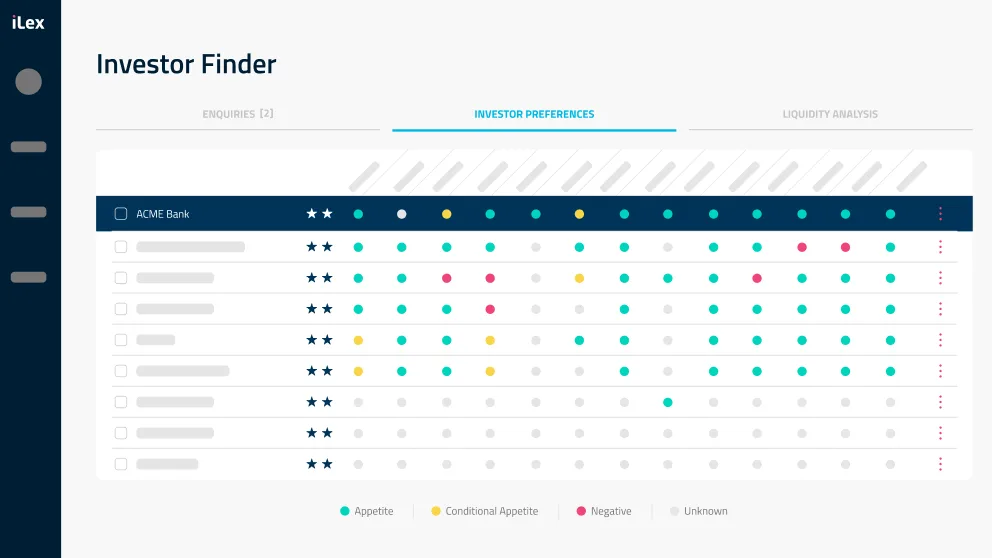
- Investor appetite insights
- Controlled deal launches
- Permissioned, tracked data rooms
- Live bookrunning dashboards
- Secondary loan marketplace
- Connected bank systems
{ How We Built It }
Development Process
How the iLex engagement came together, step by step.
- 01
Today's Loan Workflow
The platform starts from how arrangers share a loan today: inviting investors, running NDAs and data rooms, and tracking interest by hand.
- 02
Alongside the iLex Team
Harshit, Idealite's founder, worked closely with iLex's team, which combines decades in loan markets, building platforms and technology.
- 03
Both Sides of a Deal
The platform serves both sides: arrangers who distribute deals, and investors who find and join them for free.
- 04
Bank-Grade Trust
Banks vet vendors closely, so the platform keeps deal data encrypted and lets each client control what it discloses.
{ Results & Impact }
Delivering Business Value
Targeted Distribution
Arrangers find and invite relevant investors beyond their usual relationships.
Clear Deal Progress
Teams track NDAs, document activity and investor interest from launch to close.
Free Investor Access
Investors source and manage deals from leading arrangers at no cost.
Synced Back Office
Deal data can flow into banks' booking, settlement and CRM systems.
Technical details
Requirements, architecture, development, testing and deployment notes.
Technical details
Requirements, architecture, development, testing and deployment notes.
Objectives
- Reach Beyond Known Investors: Help arrangers find and invite the investors most likely to want each deal, not only the ones they already know.
- Replace Manual Deal Chasing: Take each deal from launch, NDA and data room to allocations and close in one shared workspace.
- Give Investors One View: Let investors find primary, secondary and private credit deals and track their live pipeline free of charge.
- End Re-Keying: Let deal data flow into banks' own origination, booking, settlement and CRM systems instead of being typed in again.
- Earn Banks' Trust: Meet banks' security and vendor due-diligence standards while each client controls what it discloses to counterparties.
Requirements
- Investor intelligence (Investor 360): bring together deal history, investor preferences, call notes and a market directory, and point arrangers to relevant investors through inbound enquiries, investor heatmaps, recommendations and liquidity analysis.
- Deal marketing: a marketplace, axe sheets and private investor portals for marketing loan assets.
- Deal launch (Deal Sites): set up deal information quickly, manage deal-team permissions, select and invite investors, and run a streamlined NDA workflow.
- Document sharing: a structured data room with granular, automated permissions, a shared investor FAQ and data-room activity monitoring.
- Bookrunning: follow each deal from interest to close, keep communications from several channels in one place, and report progress through dashboards and instant KPI reports.
- Deal lifecycle data (Deal 360): origination pipeline, sync with secondary and agency deal sites, a deal repository and history, automatic CRM capture and investor funnel reports.
- Investor access: free sign-up, deal sourcing and pipeline management for investors.
- Coverage: primary, secondary, private credit and club deals across all loan structures and geographies.
- Security and confidentiality: encrypted storage across multiple availability zones, MFA, IP whitelisting, client-controlled disclosure and SOC 2 Type II attestation.
Architecture
- iLex describes the platform as natively built on a microservices architecture, with specialized APIs and an open metadata model for flexible connectivity.
- An API gateway and open architecture connect deals to banks' booking, settlement and reporting, with a hybrid or private cloud option for data stewardship.
- Since May 2025, a partnership with Tesselate adds standard and custom connectors for origination, booking, settlement, reference data and CRM, aiming at straight-through processing.
- An open-source data model keeps data lineage across the deal lifecycle for analytics and compliance.
Challenges & solutions
- Manual distribution: iLex says syndicated loan distribution and secondary trading still rely on "manual, time-intensive, repetitive and error-prone processes", and MUFG Bank said in 2021 that the industry "relies on costly, manually-intensive processes". Deal Sites bring deal setup, investor invitations, NDAs, the data room and bookrunning onto one platform.
- Limited investor reach: what a bank knows about investors (deal history, preferences, call notes) sits with individual bankers, so reach depends on existing relationships and resources. Investor 360 keeps that knowledge in one place and adds heatmaps, recommendations and liquidity analysis to find relevant investors.
- Fragmented deal logistics: invitations, NDAs, data-room permissions, investor questions and allocations are handled across separate tools and channels, with little view of progress. Deal Sites add automated, granular permissions, a shared investor FAQ, data-room activity tracking, consolidated communications and live dashboards.
- Disconnected systems: iLex and Tesselate note that reliance on legacy IT and manual processes creates "organizational silos, operational inefficiencies and high cost-to-income ratios". Deal 360's API gateway and open architecture, plus Tesselate connectors since 2025, link deals to origination, booking, settlement, reference-data and CRM systems.
- No single view for investors: investors have had no one place to see primary, secondary and private credit opportunities or manage live deals. iLex gives them free access to deals from arrangers and one consolidated deal pipeline.
- Illiquid secondary market: secondary lending has suffered from "lack of liquidity", "low-level price discovery" and "limited market data". A marketplace, axe sheets and private investor portals help holders and arrangers market loan assets.
- Regulation and cost: participants face increasing regulatory requirements and rising costs, which iLex says raise the need for efficient solutions. Deal data, history and lineage stay in one record across the deal lifecycle, supporting compliance.
- Bank-grade trust: deal and client information is confidential, and banks vet their vendors closely. iLex stores data encrypted across multiple availability zones, offers MFA and IP whitelisting, lets clients control what they disclose, and achieved SOC 2 Type II attestation in March 2025.
Outcomes
- Arrangers keep what they learn about investors on one platform, not in individual inboxes and call notes.
- Deal teams can launch a deal, invite investors, run the NDA and data room, and track interest to close in one place.
- Investors can source primary, secondary and private credit deals from arrangers and manage their pipeline free of charge.
- Holders can market secondary loan positions through a marketplace, axe sheets and private investor portals.
- Banks can pass deal data to their origination, booking, settlement, reference-data and CRM systems through an API gateway and, since 2025, Tesselate connectors.
- Clients control what they disclose to counterparties, on a platform with SOC 2 Type II attestation (March 2025).
Next case study
Qritive: Faster, More Consistent Cancer Diagnosis for Labs
{ Let's Build Together }
Let's build what's next
We partner with ambitious businesses to design, build and scale digital products that create lasting value.
Contact Us