
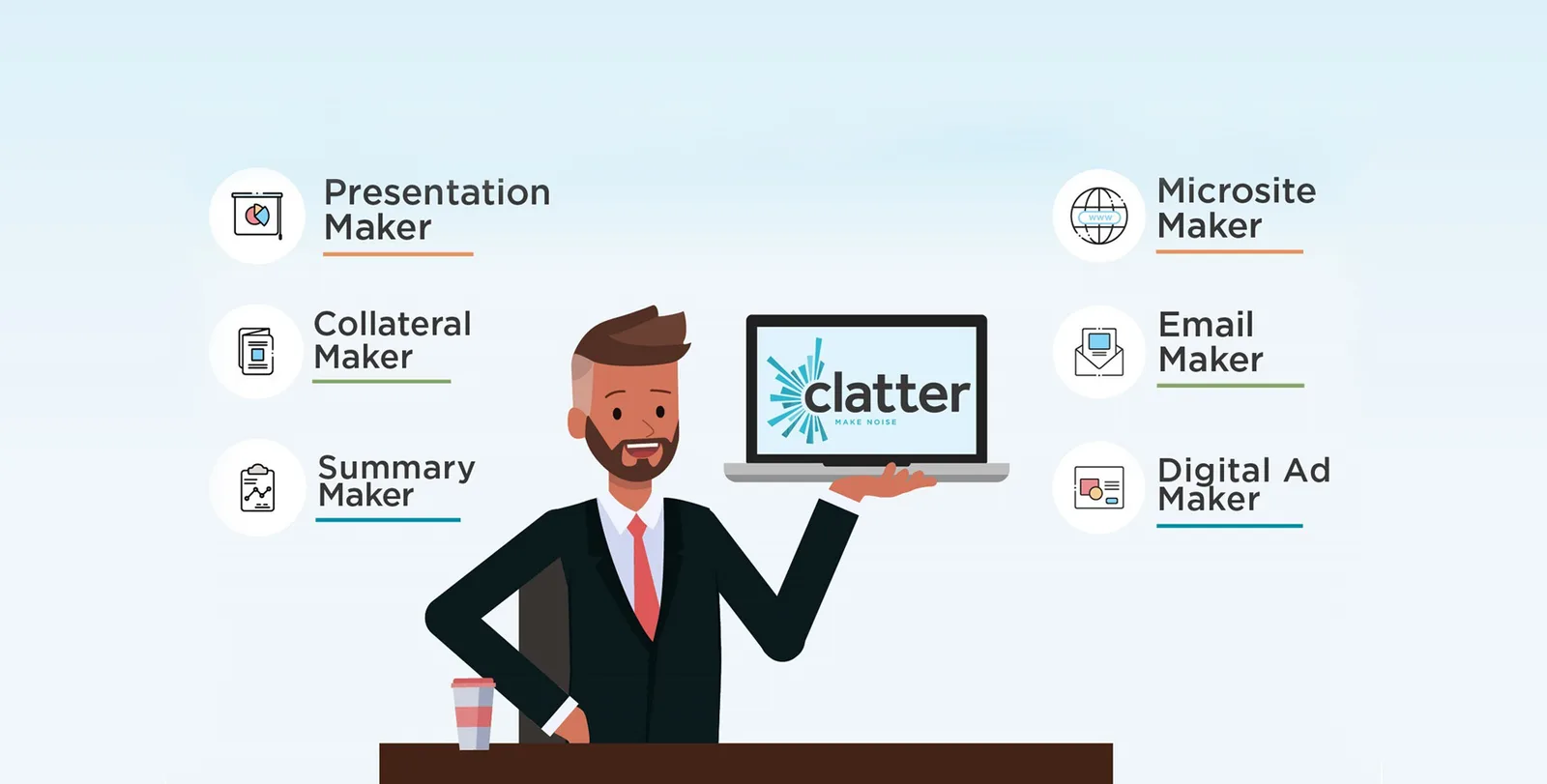
Clatter lets enterprise sales teams make on-brand decks and PDFs themselves, without a designer queue. Idealite helped Digital 112 build it.
Visit live site ↗ (opens in a new tab){ Project Overview }
About the Project
Clatter is a creative automation platform from Digital 112, a company based in Westport, Connecticut. It serves enterprise sales and marketing teams that turn out a steady stream of branded presentations and documents. Without it, each new piece goes through what Clatter calls a "days-long, decentralized, design-by-committee process": every deck and revision waits on designers, and copies drift off-brand. Clatter replaces that with locked brand templates and one library of approved content. Staff without design skills pick what they need, and Clatter turns their choices into editable PowerPoint decks or finished PDFs that stay on-brand. According to Clatter's site, UnitedHealthcare and Optum used it for presentations, marketing collateral and rate guides. Idealite helped Digital 112 build Clatter, designing its architecture and release pipelines and delivering the frontend and the Node.js backend.
- Industry
- Enterprise Software
- Services
Platform Architecture • Full-Stack Development • Document Generation • CI/CD Pipelines
{ The Challenge }
Sales Material Stuck in Design Queues
Key Challenges
- Every deck and revision waits on designers
- Design-by-committee stretches work over days
- Reps drift off-brand and off-message
- Teams hunt through old decks for slides
- Full-time design staff are expensive
{ Our Solution }
Self-Serve Material, Always On-Brand
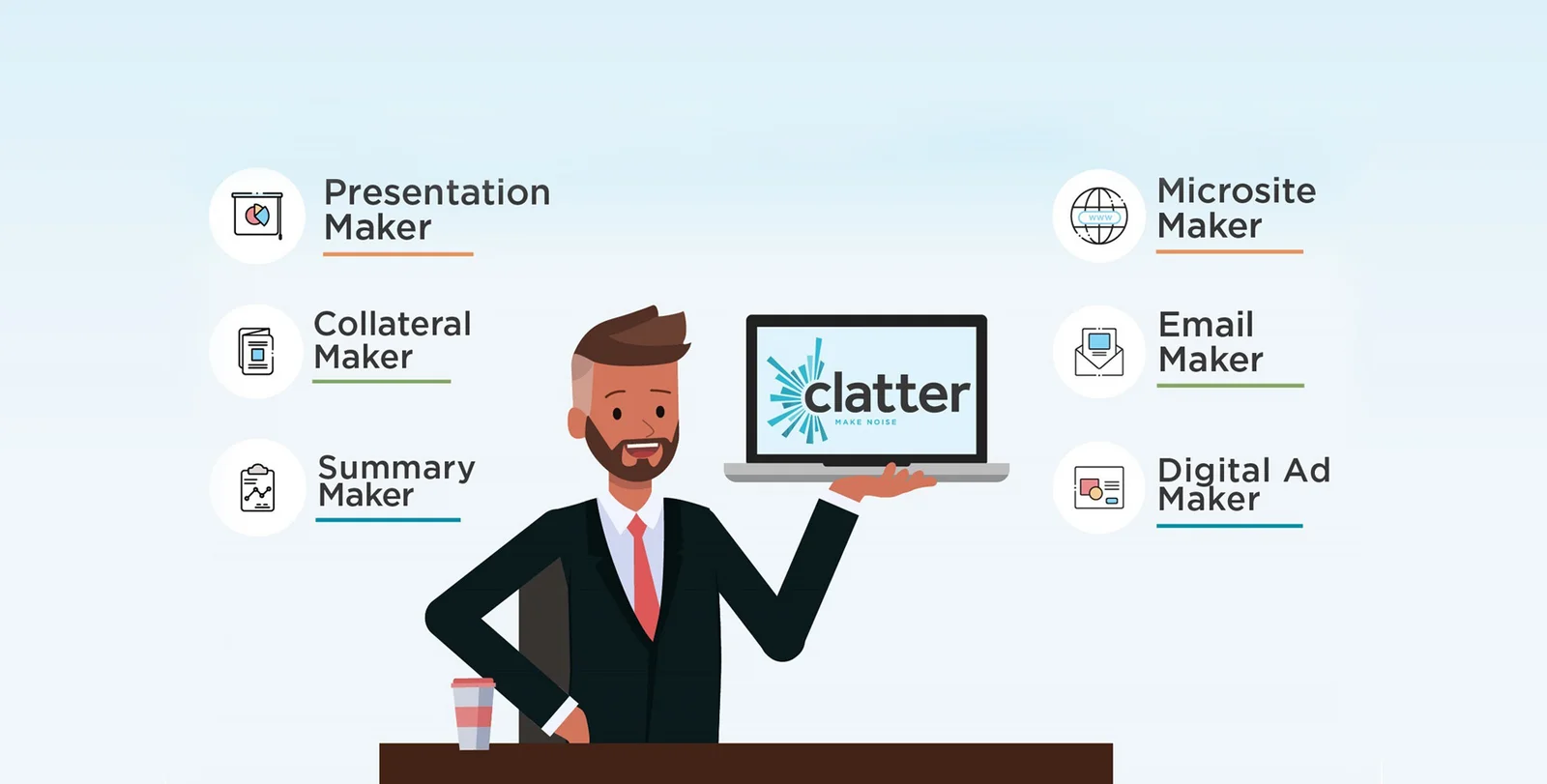
- Self-serve deck building
- Locked brand templates
- One approved content library
- PowerPoint and PDF output
- Multiple templates, one platform
{ How We Built It }
Development Process
How the Clatter engagement came together, step by step.
- 01
Understanding the Users
Started from what Clatter's users needed: sales and marketing staff producing on-brand decks and PDFs without design skills.
- 02
Designing Around Templates
Shaped the platform so every deck or PDF starts from an approved template, keeping each rep's material on-brand.
- 03
Building the Self-Serve Product
Built the self-serve product so sales and marketing staff can produce editable decks and finished PDFs from the same approved templates.
- 04
Ready to Grow
Set up automated releases so Digital 112 can keep shipping improvements to its enterprise customers.
{ Tools We Used }
Technology Stack
 Node.js
 GitHub Actions
{ Results & Impact }
Delivering Business Value
Client-Ready Pitches
Reps build tailored client decks themselves, without design skills or revision waits.
One Brand Story
Every deck and PDF keeps to approved templates, so reps stay on message.
Content Stays Current
Approved content updates reach every user automatically from one library.
Lower Design Costs
Teams create the decks they need without hiring extra designers.
Technical details
Requirements, architecture, development, testing and deployment notes.
Technical details
Requirements, architecture, development, testing and deployment notes.
Objectives
- Self-Serve Brand Material: Let sales and marketing staff without design skills build their own decks and documents.
- One Consistent Story: Tie every output to approved templates so each rep presents the same on-brand message.
- Always-Current Content: Keep approved content in one place so updates reach every user without chasing old copies.
- Lower Production Costs: Reduce reliance on full-time design staff for routine sales and marketing material.
Requirements
- Generate PowerPoint (PPT) presentations and PDF documents from templates.
- Support multiple templates within one platform.
- Keep each generated deck or PDF true to the layout of the template it came from.
- Cover all of the platform's backend and frontend requirements.
- Build and release platform changes through GitHub pipelines (GitHub Actions CI/CD).
Architecture
- Template-driven generation: each PowerPoint or PDF output is generated from one of the platform's templates.
- Node.js backend that runs the document generation.
- Frontend connected to the Node.js backend, covering the platform's frontend requirements.
- Platform architecture and CI/CD pipelines on GitHub (GitHub Actions), designed by Idealite.
- Cloud-based web application that users reach from anywhere, as described on Clatter's product pages.
Technology stack
- Node.js: backend that runs template-based PowerPoint and PDF generation.
- GitHub Actions: CI/CD pipelines for the platform.
Front end
- Platform frontend covering all of the platform's frontend requirements, delivered by Idealite.
Back end
- Node.js backend: Idealite handled all of the backend requirements.
- Template-based generation of PowerPoint (PPT) and PDF files across multiple templates.
Deployment
- CI/CD pipelines on GitHub (GitHub Actions), designed by Idealite, for building and releasing platform changes.
Challenges & solutions
- Multiple templates: the platform generates documents from several templates, so the generation logic has to work across all of them rather than for one fixed layout.
- Two output formats: the platform produces both editable PowerPoint (PPT) files and fixed-layout PDFs from its templates, so generation has to handle both.
- Layout fidelity: Clatter promises customers on-brand output, so each generated deck or PDF has to match the layout of the template it came from.
Outcomes
- Sales and marketing staff build their own decks and PDFs from approved templates instead of waiting on designers.
- Generated decks and PDFs follow their template's layout, so every rep's material stays on-brand.
- Approved content sits in one library, and updates reach every user automatically.
- Teams produce the material they need without adding full-time design staff.
Next case study
Helping LoFoods Sell Direct to Shoppers Across India
{ Let's Build Together }
Let's build what's next
We partner with ambitious businesses to design, build and scale digital products that create lasting value.
Contact Us